Emerald ash borer in Sioux Falls: treat or remove?
Every ash in Sioux Falls will be attacked. The question for each one is whether it's worth protecting or should come down before it gets brittle. Here's how to decide, using the City's and SDSU Extension's own guidance.
How it got here
Emerald ash borer was confirmed in South Dakota in May 2018, in northern Sioux Falls. It was the state's first detection. A tree crew pruning green ash for clearance noticed woodpecker damage, peeled the bark and found galleries and a larva. About 250 infested trees were identified on the north side at the time, and the state estimated the infestation was three or four years old. SDSU Extension now says the beetle probably arrived in 2014 or 2015, north and east of the airport, and that infested ash are found throughout the city limits. About 40 percent of the city's trees were ash. As of June 2025 the state counted 13 South Dakota communities with confirmed EAB, including Baltic, Brandon, Canton, Crooks, Hartford, Lennox, Sioux Falls and Tea.
What the City is doing
The City runs a 10-year EAB response plan. By September 2024, Parks and Recreation had removed nearly 17,000 ash from City property. It estimated about 45,000 ash still standing on private property, and its 2024 Forest Health Survey condemned 530 private ash, about triple the year before. City staff said that number could double or triple again. Ash in residential parking strips are removed, and the stumps ground, at no cost to the abutting owner unless the owner treats the tree. Since September 2018 it has been illegal to plant ash anywhere in the city. Dead, diseased or infested trees are declared a nuisance under Code § 94.015. Owners must treat or remove them, and the director can order removal and, if the owner doesn't comply, have the work done and assess the cost against the property.
How to read your tree
- Years 1–2: the top of the crown thins, with small, light-green leaves.
- Year 3: dieback in the crown and sprouts on the trunk and big limbs.
- Years 4–5: heavy woodpecker activity, bark stripped in pale "blonded" patches, and D-shaped exit holes about 1/8 inch across. The City says exit holes at eye level suggest the top of the tree is dead.
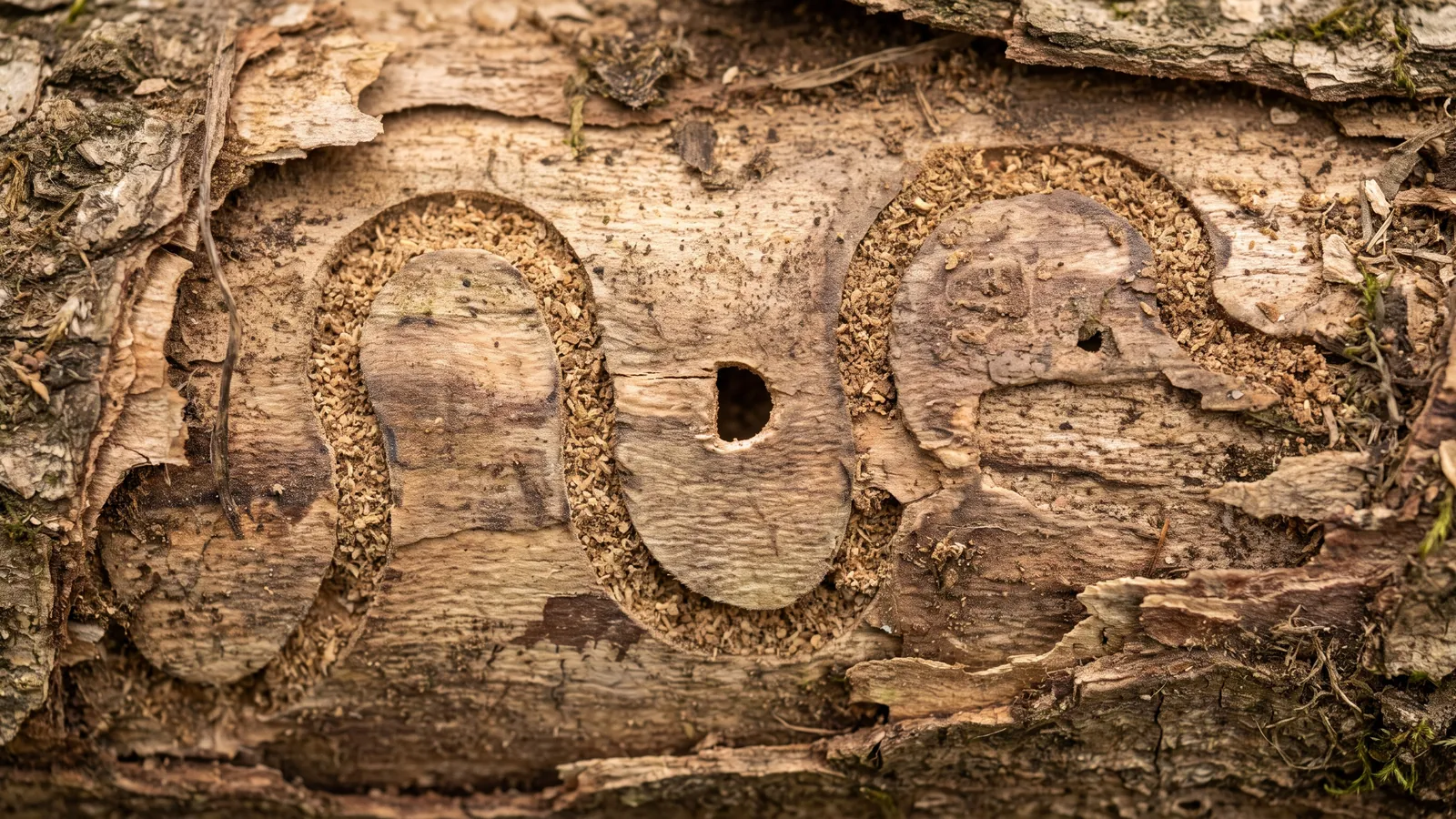
- Under the bark: S-shaped galleries about 1/8 inch wide packed with frass.
Inside Sioux Falls, the City says to assume EAB is present. You don't need an inspection to confirm it. Infested trees can survive one to seven years but typically die after about five years of attack.
Treat or remove
SDSU Extension's August 2026 alert gives the rule of thumb. An untreated ash with about 40 percent canopy decline is too late to treat. One with about 30 percent may survive treatment, but dead wood doesn't recover. Its treatment bulletin says emamectin benzoate trunk injection can be used on trees with less than 35 percent decline, that treatments are reported more than 98 percent effective when properly applied, and that fewer than 1 percent of untreated ash survive. Homeowner soil products work best on trees under about 10 inches across, so SDSU recommends a commercial service for bigger trees. The City puts treatment at $150 to $350 per tree every two years for trunks 10 to 25 inches across. It says intervals may stretch to four years or more after the main outbreak, which it puts at about 10 to 12 years, and that treatment continues for the life of the tree.
Treat if the tree is healthy, well placed and worth the shade. Remove it if it's past about a third of its canopy, poorly placed, or one you wouldn't miss. The City is blunt about it: removing a living ash costs much less than removing a dead, brittle one.
The calendar and the wood
The City says not to prune or remove ash from Memorial Day to Labor Day, when adult beetles are flying and drawn to fresh wounds, and moving ash wood is prohibited in that window. SDSU's ideal trunk-injection window is leaf-out to mid-June. The state's EAB quarantine covers all of Brookings, Codington, Grant, Minnehaha, Lincoln, Turner and Union Counties. Ash logs, lumber, chips and mulch, and all hardwood firewood, move freely inside those counties but need a state permit or compliance agreement to leave. Hardwood firewood from the infestation area is banned from all South Dakota state parks.
Common questions
Do I need to have my ash inspected?
Not in Sioux Falls. The City says EAB is assumed present everywhere in the city, so you don't need to call the City, Extension or the state to confirm it.
Can I treat a tree that's already thinning?
If it's lost less than about 30 percent of its canopy, maybe. At about 40 percent, SDSU says it's too late. Dead branches won't leaf out again even if the treatment works.
Will the City make me remove my ash?
If the Forest Health Survey finds it dead, diseased or infested, the owner gets a letter to remove it, with a deadline based on the hazard. You can appeal to the Parks and Recreation Board within three days.
Can I plant a new ash?
No. Planting ash has been illegal in Sioux Falls since September 2018.
Related: Ash tree removal · EAB treatment · When to prune · Debris and ash wood